By: Bryon L. Garner, PhD
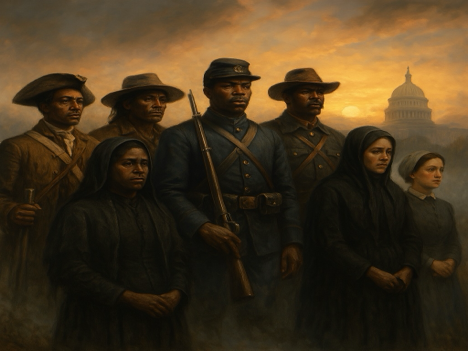
On this Memorial Day, as we gather to honor those who made the ultimate sacrifice in service to our nation, we must begin by acknowledging a profound truth that has been deliberately obscured for more than a century: the very origins of this sacred observance lie not in official proclamations or government decrees, but in the revolutionary act of remembrance performed by formerly enslaved Black Americans who understood that “our survival is revolution” and “our memory is resistance.” This Memorial Day calls us to reckon with the full complexity of American patriotism, to honor all who have served and died, and to embrace a transformative vision of what it means to love a country that has not always loved us back.
The true genesis of Memorial Day lies in Charleston, South Carolina, where on May 1, 1865, just weeks after the Confederate surrender at Appomattox, 10,000 freed people transformed a symbol of Confederate oppression into hallowed ground. The Washington Racecourse and Jockey Club, which had been converted into a makeshift prison where 257 Union soldiers died in horrific conditions, became the site of what historian David Blight discovered to be the first Decoration Day. Twenty-eight Black workmen spent two weeks exhuming bodies from a hastily dug mass grave, reburying each soldier with dignity, and erecting a fence with an archway inscribed “Martyrs of the Racecourse”.
What followed was extraordinary: a procession of 3,000 Black schoolchildren carrying armfuls of roses, members of the 54th Massachusetts and 35th U.S. Colored Troops drilling in formation, and ministers reciting Psalm 91:5—”You will not fear the terror of the night, nor the arrow that flies by day”. As the New York Tribune reported, this Decoration Day culminated in freedwomen placing “crowns of oak and laurel” on graves while singing “John Brown’s Body”—a direct rebuke to Confederate attempts to erase Union sacrifice. This was not merely a mourning ceremony but a revolutionary declaration that Black Americans would be the keepers of memory, the guardians of truth, and the architects of a more inclusive patriotism.
Yet this radical act of remembrance faced immediate suppression. By 1877, white Southerners had co-opted the ritual into “Memorial Day,” shifting focus to Confederate dead while Northern politicians promoted a “reunion” narrative that sidelined Black contributions. The Racecourse itself was bulldozed in 1901 to build Hampton Park, its Black origins buried beneath statues of John C. Calhoun and Wade Hampton. This erasure was not accidental—it was part of a systematic campaign to deny Black Americans their rightful place as co-creators of American freedom and memory.
The Continuing Struggle for Recognition and Equity
The suppression of Decoration Day’s origins mirrors broader patterns of exclusion that continue to shape Black veterans’ experiences today. Despite Black Americans comprising 17% of active-duty military personnel while representing only 13% of the general population, they face persistent discrimination in both military service and veteran benefits. Recent Government Accountability Office reports reveal that Black veterans receive disability benefits approval at significantly lower rates than their white counterparts—61% compared to 75% for white veterans. For conditions like hearing loss, the disparity is even starker: white veterans see 45% approval rates while Black veterans achieve only 23% approval.
These disparities are not mere statistics; they represent lived experiences of racialized moral trauma—the psychological injury that occurs when those who have served their country with honor return home to face systematic discrimination and exclusion. Secretary of Defense Lloyd Austin, himself a Black veteran who rose to the highest levels of military leadership, acknowledges this reality: “There’s not a day in my life when I didn’t wake up and think about the fact that I was a Black man”. Even at the pinnacle of military success, Austin found himself adapting to environments where his qualifications were questioned because of his race, sometimes having others deliver his briefings because he felt white officers were more likely to listen to them.
The Black Veterans Project’s research documents how 71% of Black veterans report experiencing discrimination during their military service. This discrimination manifests across multiple dimensions: Black troops remain over-represented in service-oriented roles while having diminished presence in the officer corps, stark underrepresentation in elite training schools, and disproportionate rates of disciplinary action. Moreover, Black veterans face higher rates of homelessness, unemployment, and mental health challenges in civilian life, often compounded by the additional burden of navigating racist institutions while managing service-connected trauma.
These contemporary challenges illuminate why the concept of Black veteranality—the intersection of racial identity and military service within systems of persistent exclusion—remains critically important for understanding American patriotism. Black veterans embody a profound contradiction: they demonstrate ultimate patriotic commitment through military service while simultaneously confronting the reality that their racial identity subjects them to second-class treatment in the very institutions they served to protect.
The Complexity of Patriotic Identity in Black Military Experience
For Black veterans, patriotism cannot be understood through traditional frameworks that position loyalty and critique as opposing forces. Instead, their experiences reveal what we might call “transformative patriotism”—a form of national attachment that simultaneously embraces American ideals while working actively to expand their implementation to include previously excluded groups. This patriotism challenges conventional boundaries between loyalty and dissent by arguing that genuine patriotic commitment sometimes requires opposition to government policies and institutional practices that violate constitutional principles of equal protection and democratic participation.
The theoretical foundations of moderate patriotism, while attempting to balance national attachment with ethical constraints, prove inadequate when applied to Black veterans’ experiences. When the institutions that patriotism is meant to support have systematically excluded certain groups, applying ethical principles becomes more complex than traditional frameworks suggest. Black veterans may find themselves defending American ideals against American institutions, creating a patriotic consciousness that appears paradoxical within conventional understanding but makes perfect sense when viewed through the lens of racialized moral trauma.
This complexity extends to the relationship between patriotism and religious identity. Research reveals that Black Americans are more likely to hold Christian nationalist beliefs (34%) than other groups, including white Americans (30%). However, this apparent embrace of Christian nationalism among Black Americans functions differently than among white adherents. For Black Christians, particularly veterans, emphasizing Christian identity can serve as a form of identity management—a way of asserting belonging in American society when their racial identity is used to question their patriotic authenticity. When exposed to ethnonationalist rhetoric that defines Americanness through white identity, Black Christians may respond by emphasizing their Christian identity as a means of claiming their place at the center of American identity.
The lived reality of Black veterans navigating these complex intersections reveals the inadequacy of theoretical approaches that treat patriotism, nationalism, and religious identity as fixed categories with clear boundaries. Their experiences demonstrate that relationships between these identities are fluid and contextual, shaped by ongoing negotiations around belonging, recognition, and inclusion in American society.
The story of George Washington Williams, a United States Colored Troops (USCT) veteran and America’s first Black professional historian, provides a powerful example of how Black veterans have historically challenged official narratives while maintaining deep patriotic commitment. Williams spent seven years documenting the valor of 178,975 USCT soldiers in his 1888 masterwork, “A History of the Negro Troops in the War of the Rebellion.” Drawing on interviews with aging veterans and War Department records, Williams revealed how Black soldiers captured 22 Confederate flags at Fort Wagner and comprised 25% of Union forces at Nashville’s decisive 1864 victory.
White academia responded with vitriol. Historian James Ford Rhodes dismissed Williams’ work in 1893, asserting that “the Negro has no history… no heroes”. The War Department sealed USCT pension records until 1915, while the 1896 Plessy v. Ferguson decision codified the lie that Black soldiers’ service held no political significance. Williams died in 1891 and is buried in an unmarked grave in England after attempting to expose Belgian atrocities in the Congo—a martyr to truth-telling whose epitaph could read “He made witnesses of the erased”.
Williams’ legacy reminds us that the struggle for recognition and inclusion is not new, nor is the courage required to speak truth to power about America’s failures to live up to its founding ideals. As Williams wrote in 1888: “The Negro’s part in saving the Union will survive the sneers of his enemies and the neglect of his friends”. His prophetic words resonate today as Black veterans and their families work to ensure their service and sacrifice are fully recognized and honored.
Contemporary Challenges and Ongoing Resistance
Today’s reality shows that the struggles Williams documented continue in new forms. As 34 states restrict teaching about systemic racism, Black communities find themselves once again fighting to preserve historical memory and resist official narratives that diminish their contributions. The persistence of racial disparities in veterans’ services, from healthcare access to disability benefits, demonstrates that the promise of equal treatment for military service remains unfulfilled.
Yet Black veterans continue to embody the spirit of the 1865 Charleston marchers through contemporary acts of resistance and remembrance. Organizations like the Black Veterans Project work to document and address ongoing inequities while connecting current struggles to historical patterns of exclusion. Their research collaborations with institutions like Yale Law School and Howard University’s Thurgood Marshall Civil Rights Center represent modern versions of Williams’ truth-telling mission, using data and scholarship to challenge systems of discrimination.
The work extends beyond documentation to direct service and advocacy. When veteran service organizations help Black veterans file disability claims, each successful case represents not just individual support but resistance to systemic inequity. When Black veterans share their stories of discrimination and perseverance, they continue the tradition of bearing witness that connects them to the Charleston marchers and Williams’ scholarly courage.
Toward an Inclusive Future: Reimagining American Patriotism
The experiences of Black veterans point toward the urgent need for a more inclusive conceptualization of American patriotism—one that acknowledges historical injustices while maintaining hope for democratic progress. This reimagining requires moving beyond traditional frameworks that position loyalty and critique as opposing forces, instead embracing transformative patriotism that sees the struggle for justice as the highest form of national service.
Inclusive patriotism is founded on recognizing that America’s greatest patriots have often challenged the nation to live up to its founding ideals. Frederick Douglass, who criticized American slavery while maintaining faith in American principles, exemplified this transformative approach. Similarly, Black veterans throughout history have demonstrated patriotism not through uncritical support for government policies but through their willingness to serve their country while simultaneously working to expand the meaning of American freedom and equality.
Contemporary Black veterans continue this tradition by offering what we might call “aspirational patriotism”—a form of national attachment that loves America not for what it has been but for what it could become. This patriotism recognizes that the American experiment remains unfinished and that military service represents one form of contribution to that ongoing project. Unlike traditional patriotism that celebrates national achievements, aspirational patriotism acknowledges national failures while maintaining a commitment to the ideals that make transformation possible.
Educational institutions have a particular responsibility to promote inclusive patriotism by teaching the full complexity of American history rather than sanitized versions that obscure the struggles of marginalized groups. When students learn about the segregated military during World War II alongside the heroic service of Black units like the Tuskegee Airmen, they develop more nuanced understandings of both patriotism and democracy. When they discover the true origins of Memorial Day in the Charleston Racecourse, rather than accepting simplified official narratives, they gain appreciation for the ongoing struggle to define American memory and meaning.
Policy implications of inclusive patriotism extend across multiple domains of American life. Veterans’ services must be reformed to address the specific needs of marginalized veterans, including culturally competent mental health care and programs that address racialized moral trauma. Employment and educational programs for veterans must acknowledge and combat the discrimination that Black and other minority veterans face in civilian life. These policy changes represent concrete ways of demonstrating that America values the service of all its veterans, not just those from dominant groups.
A Call to Revolutionary Memory
As we observe this Memorial Day, we must heed the call embedded in the Charleston marchers’ declaration: “Our survival is revolution. Our memory is resistance”. To honor those who have died in service to this nation, we must commit ourselves to the revolutionary work of expanding American democracy to include all who have served and sacrificed. We must resist official narratives that erase or diminish the contributions of Black veterans and other marginalized servicemembers. We must demand that our institutions live up to the ideals for which so many have given their lives.
The path forward requires what Williams called making “witnesses of the erased”—ensuring that the stories of Black veterans, from the Charleston marchers to contemporary servicemembers facing discrimination, are told and remembered. It requires supporting organizations and policies addressing ongoing veterans’ services inequities. It requires educating ourselves and others about the full complexity of American military history and the ongoing struggle for equal recognition and treatment.
Most importantly, it requires embracing a form of patriotism worthy of those we commemorate today—a patriotism that honors their sacrifice by working to create the more perfect union for which they gave their lives. As the 54th Massachusetts Infantry Regiment’s cry echoed across the Charleston Racecourse in 1865: “We’ll stand the storm, it won’t be long!”. That storm continues, but so does our commitment to standing firm in the face of injustice while maintaining hope for transformation.
This Memorial Day, as we lay wreaths on graves and offer prayers for the fallen, let us remember that true honor requires more than ceremony—it demands action. The Black veterans buried in our national cemeteries, from Civil War battlefields to Arlington National Cemetery, rest alongside white comrades who shared the common experience of military service even as they lived in a society that treated them differently based on race. Their shared sacrifice calls us to build the inclusive democracy they fought to defend.
The transformation of American patriotism will not happen through grand gestures alone but through countless individual acts of resistance, remembrance, and reconstruction. When we challenge racist narratives about military service, when we support equitable policies for all veterans, when we teach the whole truth about American history, we continue the revolutionary work begun by the Charleston marchers in 1865. We honor those who died and those who lived to carry forward the struggle for justice and equality.
From the Racecourse to Williams’ unmarked grave, from contemporary struggles for VA equity to the ongoing fight for inclusive education, the truth echoes across generations: our survival is indeed revolution, and our memory is resistance. In this season of remembrance, let us commit ourselves to the revolutionary patriotism that sees love of country not as acceptance of its failures but as determination to fulfill its highest promises. This is how we truly honor the fallen—by ensuring that their sacrifice contributes to creating an America worthy of their devotion, an America that finally lives up to the ideals for which they gave everything